

Cross-scene learning
Jointly learns indoor and outdoor datasets under their native protocols.
Cross-Scene 3D Semantic Occupancy Prediction
Towards Unified Indoor-Outdoor 3D Occupancy Prediction
1Pengcheng Laboratory 2Shanghai Artificial Intelligence Laboratory 3Harbin Institute of Technology, Shenzhen 4Southern University of Science and Technology
One shared model predicts semantic occupancy across room-scale indoor scenes and street-scale outdoor environments with heterogeneous cameras, voxel grids, and semantic taxonomies.
Demo
A single OccAnyScene model handles heterogeneous indoor and outdoor occupancy protocols without switching models.
Overview
Existing occupancy models are usually specialized to one camera setup, spatial range, voxel resolution, and taxonomy. OccAnyScene instead uses the pixel frustum as a scene-adaptive geometric unit.
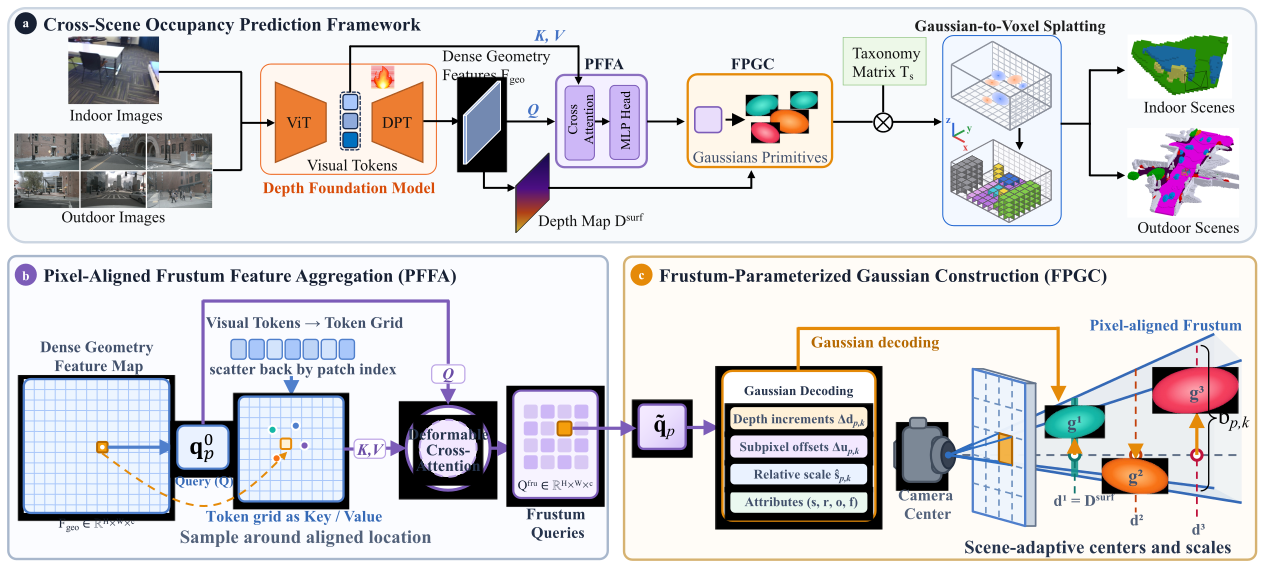
3D semantic occupancy prediction is fundamental to scene understanding, yet existing methods are typically specialized to fixed scene types and occupancy protocols. Such specialization is poorly suited to autonomous systems operating across environments with different spatial demands: open roads require long-range, coarse-grained perception, whereas confined indoor spaces demand short-range, fine-grained understanding. Maintaining and switching between separate models for each setting complicates deployment and scales poorly as operating environments diversify. We therefore introduce Cross-Scene 3D Semantic Occupancy Prediction, a task that requires one model to handle heterogeneous indoor and outdoor scenes with different camera configurations, spatial ranges, voxel specifications, and semantic taxonomies. To address the challenge of metric-consistent yet scene-adaptive image-to-3D lifting, OccAnyScene builds a continuous Gaussian representation upon a pretrained depth foundation model, combining Pixel-Aligned Frustum Feature Aggregation with Frustum-Parameterized Gaussian Construction.
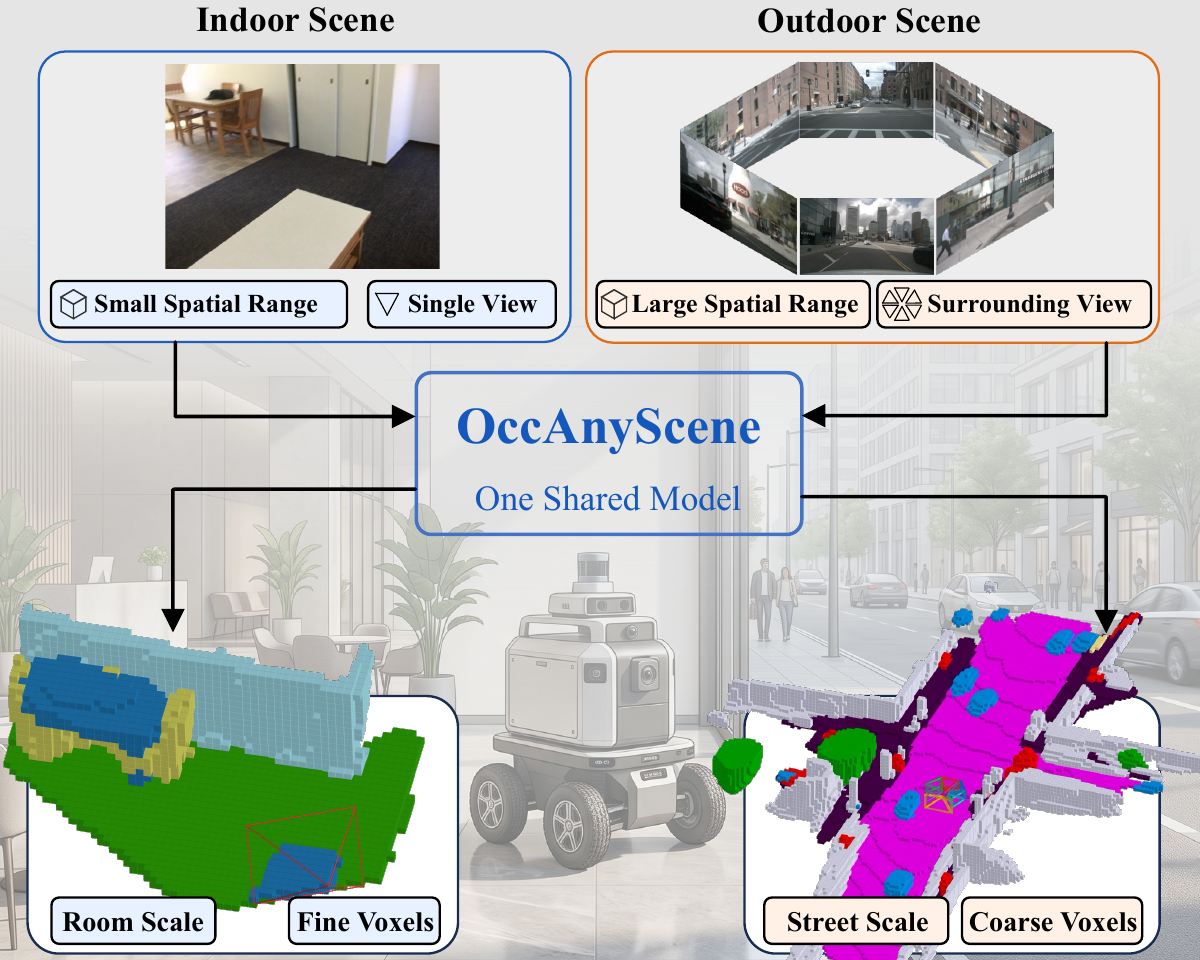
Jointly learns indoor and outdoor datasets under their native protocols.
Builds a context-rich frustum query for every feature pixel.
Adapts Gaussian positions and scales to camera geometry and scene depth.
Method
PFFA aggregates geometry and visual context into frustum queries. FPGC decodes those queries into Gaussian primitives whose centers and scales are expressed relative to the corresponding pixel frusta.
Results
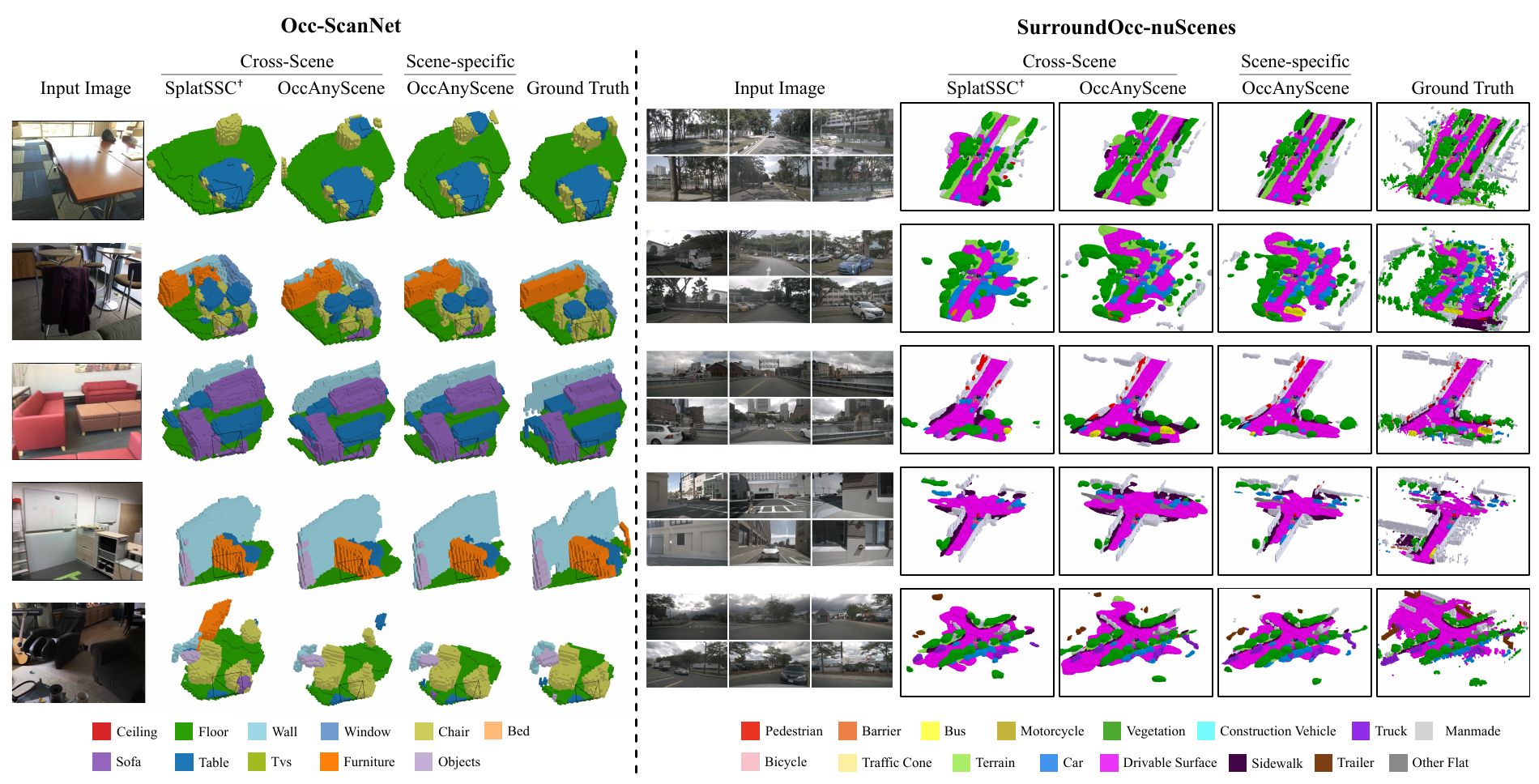
With DAv3 as the image encoder, one shared cross-scene model closely matches separately trained scene-specific models on both indoor and outdoor benchmarks, with only 0.41 and 0.19 mIoU gaps, respectively.
Only -0.41 mIoU with joint indoor-outdoor training
Only -0.19 mIoU with joint indoor-outdoor training
Occlusion reasoning
Surface-relative depth increments move selected Gaussians behind foreground occluders, enabling the model to represent both visible and inferred scene content.
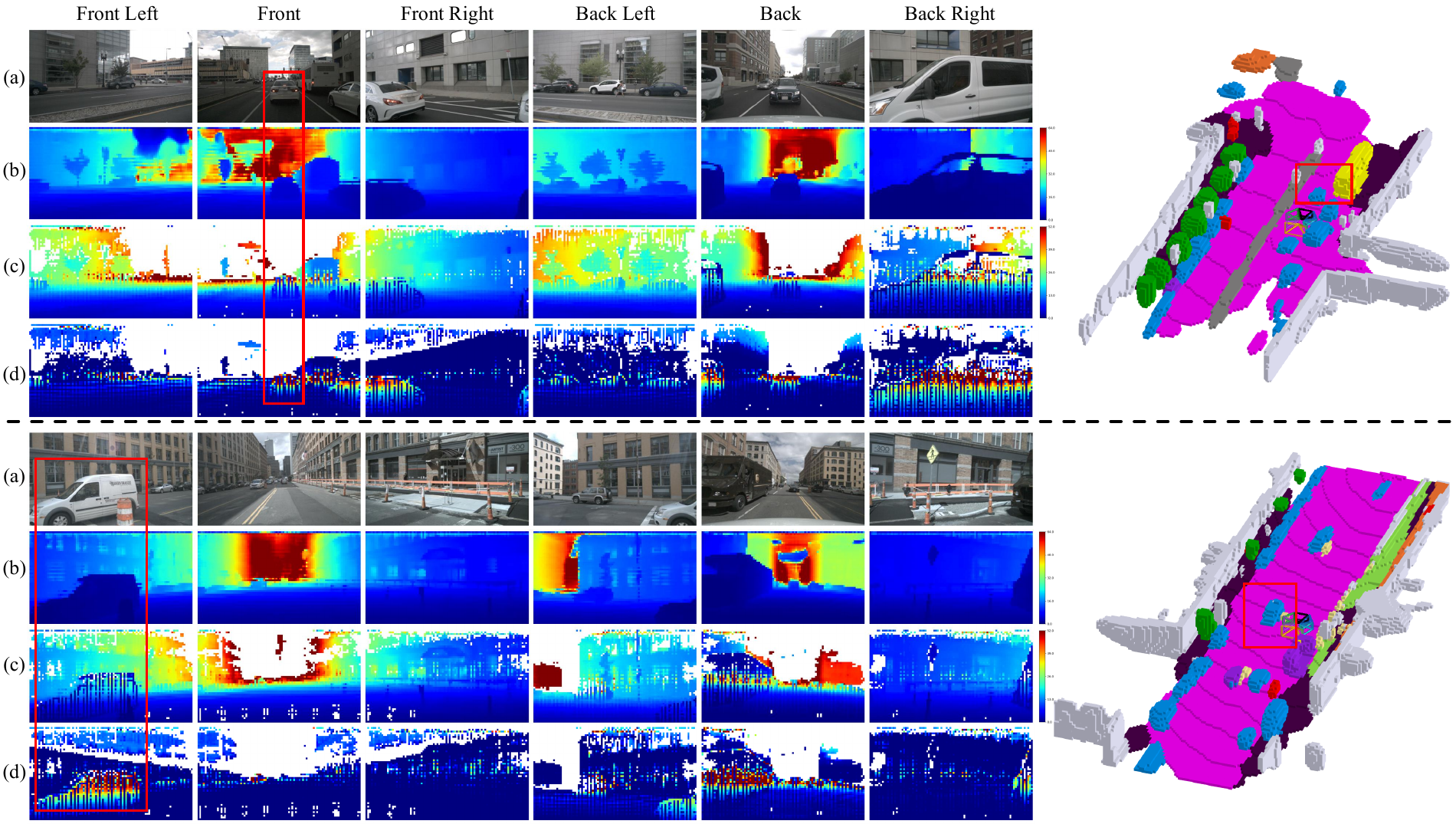
Occlusion-aware Gaussian positioning on SurroundOcc-nuScenes. The six columns correspond to the six camera views. The rows show (a) input images, (b) predicted surface depth, (c) the depth of the closest-to-camera Gaussian among the K = 3 Gaussians decoded from each pixel frustum, and (d) the corresponding surface-relative depth increment. Row (c) is obtained by adding (d) to (b), while the right panel shows the final semantic occupancy prediction. Red boxes highlight representative foreground occlusions, where spatially alternating large increments move Gaussians behind visible surfaces.
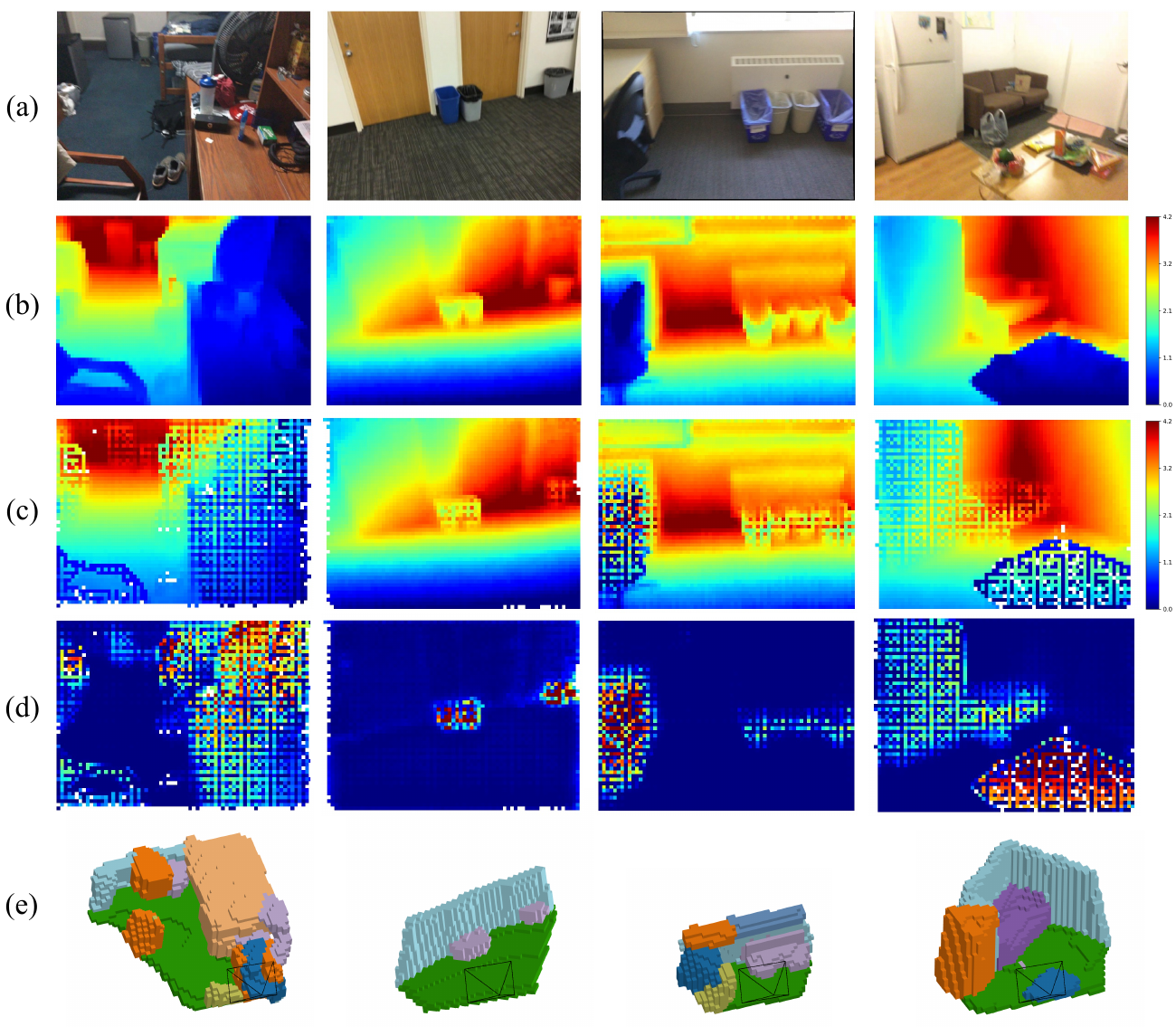
Occlusion-aware Gaussian positioning on Occ-ScanNet. The rows show (a) the input image, (b) predicted surface depth, (c) the depth of the Gaussians decoded from each pixel frustum, (d) the surface-relative depth increment, and (e) the final semantic occupancy prediction. The mosaic-like increment patterns in foreground regions indicate that neighboring pixels distribute their Gaussians between visible surfaces and occluded backgrounds.
Efficiency
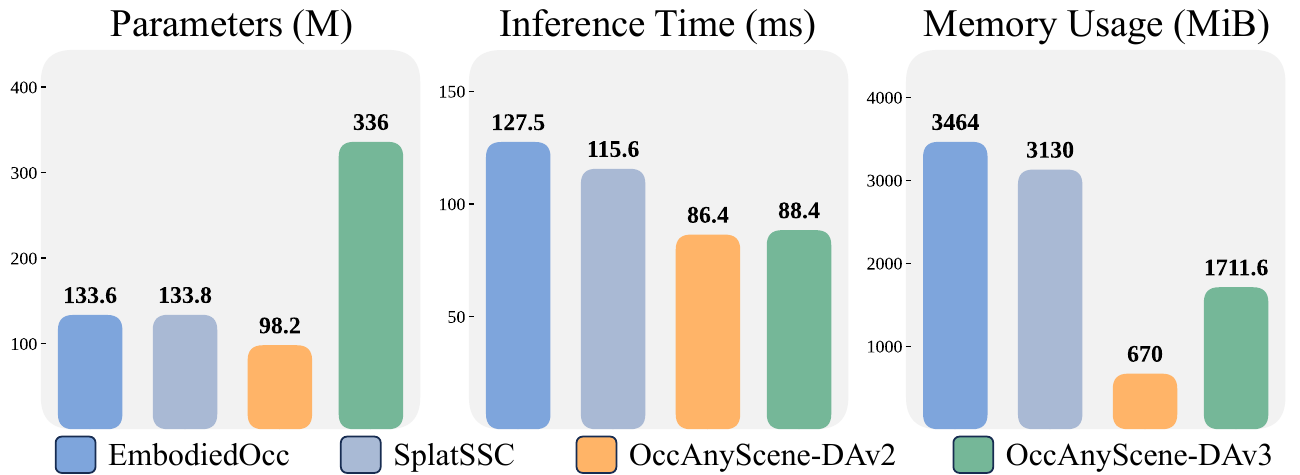
OccAnyScene-DAv2 combines the smallest parameter count among the compared methods with low inference latency and memory usage.
Citation
If you find this work useful, please consider citing the paper.
@article{chen2026occanyscene,
  title   = {OccAnyScene: Towards Unified Indoor-Outdoor 3D Occupancy Prediction},
  author  = {Junjie, Liu and Wanshui, Gan and Zitong, Dai and Guiping Cao and Yan Li and Ke Chen and Dongmei Jiang and Xiangyuan Lan and Jianguo Zhang},
  journal={arXiv preprint arXiv:2608.08696},
  year    = {2026}
}